

A lot of US brands ask us the same thing lately: should we be doing nearshore manufacturing for us brands instead of China? They usually ask it like they already feel guilty about it.
We run a women’s clothing factory in Dongguan. Been at it since 2010. Most of our customers are American and European brands, so we hear both sides of this fight. I’ll give you our side. But I’ll also tell you when Mexico is genuinely the better call — because sometimes it is, and pretending otherwise just wastes everyone’s time.
Ⅰ What is nearshore outsourcing in garment production?
Basically, if a brand or trader chooses to produce apparel by relying on the services of a factory that is in a geographically close country or region that has similar time zones and short transportation distances compared to traditional long distance contract manufacturing in overseas applications, then this would be an example of nearshore manufacturing.
American companies are not relying on producing goods through a long Trans-Pacific distance. They’ve been transferring their orders to the factories in the Americas. and the benefits of this approach include faster response to orders, reduced lead times, lower costs of communication, and a more secure overall supply chain.
For buyers, nearshoring doesn’t mean they can get their products at a lower price,but it has provided them with more options to buy at a lower price than they would otherwise have to pay.
Ⅱ Four Core Reasons Driving the Rapid Growth of Nearshore Outsourcing
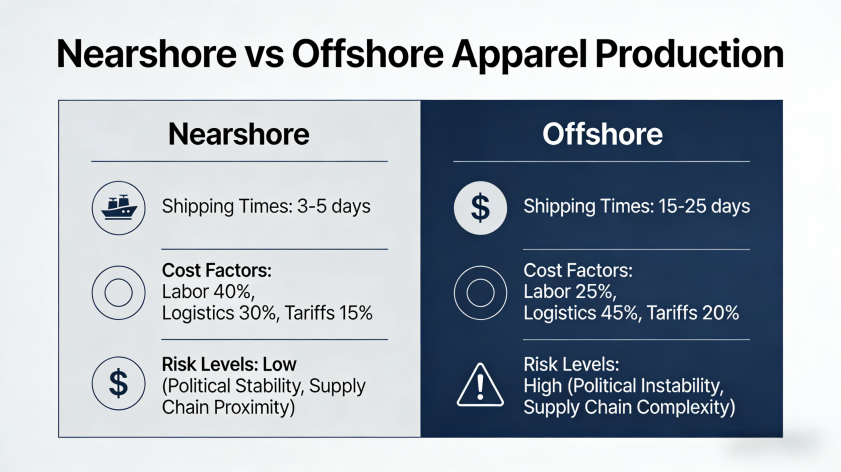
In the last ten years, the global apparel supply chain has become increasingly concentrated and interconnected. As a result, any disruption (logistical congestion, delays at ports, or geopolitical disruptions) halts freight shipments across the entire schedule due to the interconnectedness of the apparel supply chain.
1.Logistics data on the apparel industry shows the following:
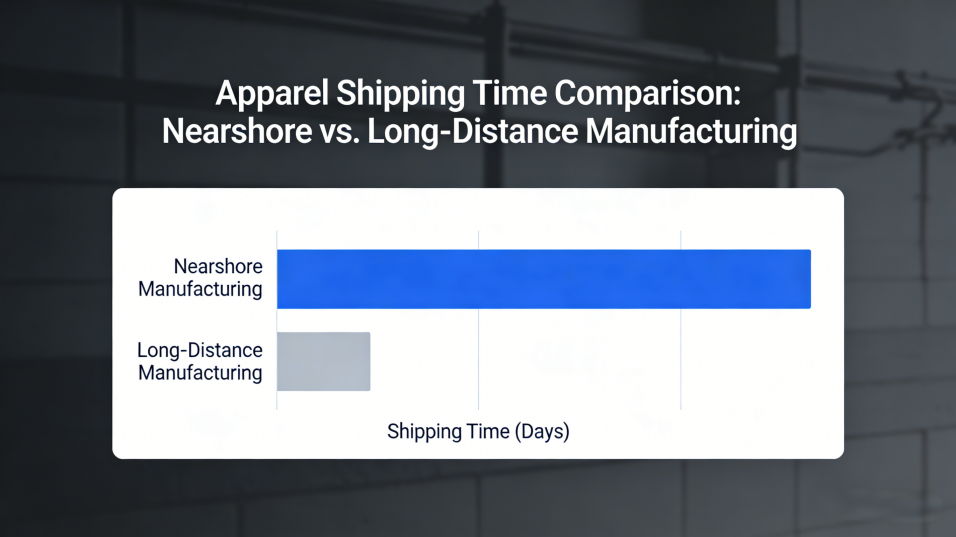
(a) Typical trans-pacific shipping time of 25–35 days can rise to over 60 days during periods of congestion.
(b) Nearshore supply chains can shorten travel time by 60%–80%.
(c) Inventory days turns can be reduced from 90 days to 30–45 days, depending
on the supply chain configuration.
Brands generally have one fear, which is goods being sold while their reorder is still enroute. So, the main objective of supply chain optimization is to decrease this uncertainty. Nearshore outsourcing is very effective and direct way to do so.
2. The demand structure of the US apparel manufacturing industry has undergone significant changes.
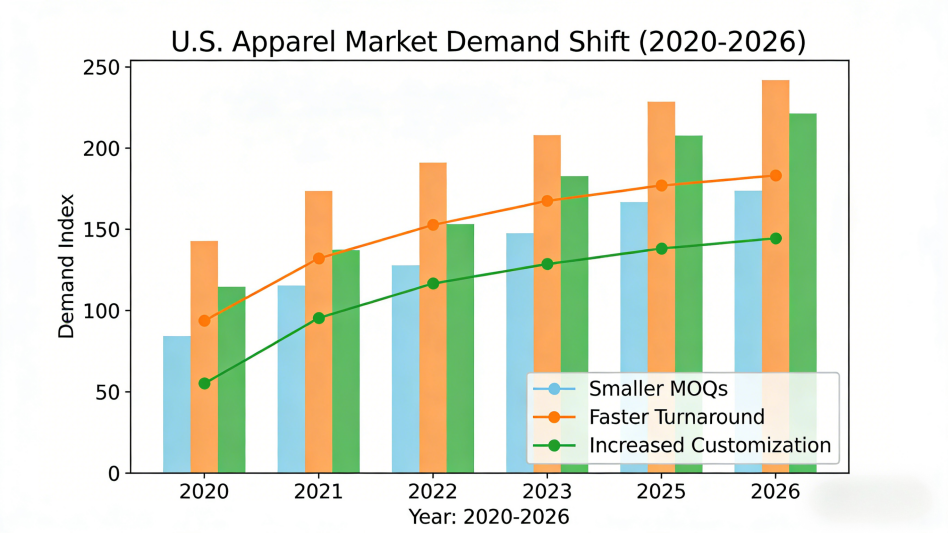
One of the main changes in the US apparel manufacturing industry is the shift away from large-scale basic OEM manufacturing toward other modes of production. One of the most notable changes in market demand is the growing preference for “rapid order replenishment,” “small-batch quick response,” and “high-quality customization” products.
Brands that manufacture clothing in the USA and their retail customers are trending towards quicker new product launch speeds (the cycle time from concept to production has shortened from quarterly cycles to monthly or even weekly cycles); less unsold inventory and less capital tied up in inventory; and much higher standards for compliance, environmental regulation and the amount of transparency with respect to product delivery.
Factories far away have a tough time keeping up with this fast pace. On the other hand, nearby models fit these new needs,For a China factory, this means competing on speed and development capability — not on taking every small order that comes in.
3. Changes in cost structure mean that the low-price advantage is no longer absolute.
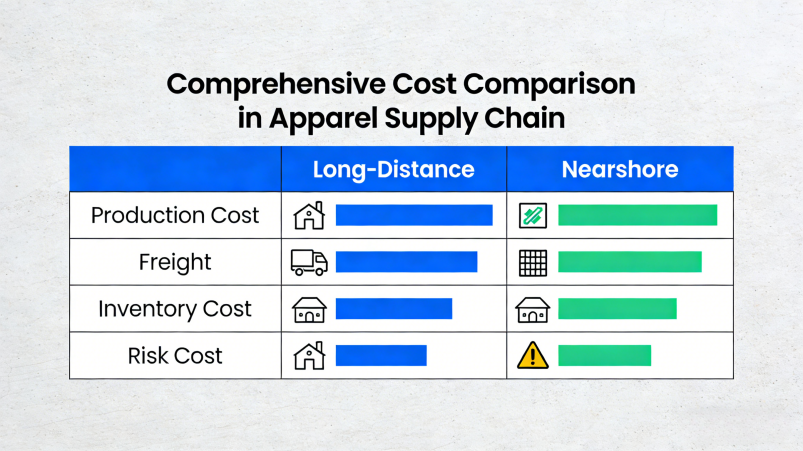
We have compiled a comparison of overall industry costs in recent years for suppliers’ reference:
| Cost Item | Long-Distance Manufacturing | Nearshore Outsourcing |
| Production cost per unit | Lower | Slightly higher |
| Ocean freight & surcharges | Very high | Low |
| Inventory holding cost | High | Low |
| Risk cost (delay/cancellation) | High | Very low |
| Overall comprehensive cost | Relatively high | More balanced & controllable |
The table shows that even though long-distance outsourcing is better for labor costs, when looking at the total costs of each, nearshore outsourcing is actually more cost-effective when you include factors like logistics, inventory, risks, and delay losses.For simple, repeat orders, that table usually holds. For orders involving fabric development, printing, or complex construction, the sourcing advantages in China flip the last row — we’ll get to that below.
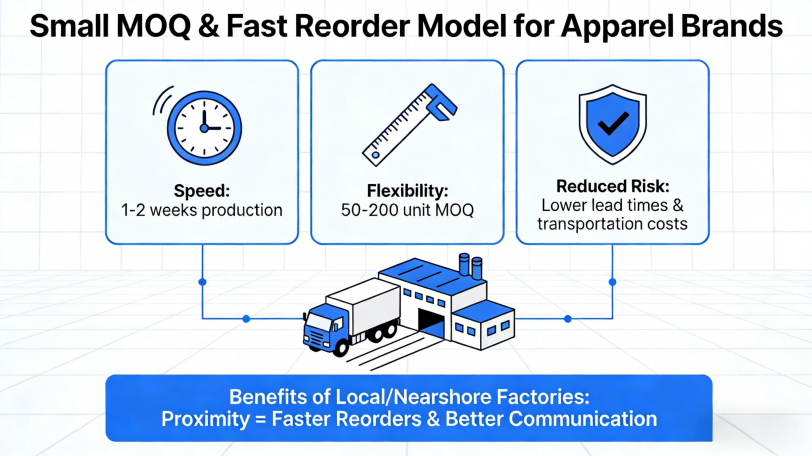
4. Small-batch, quick-response production is becoming the norm, giving local garment factories a greater advantage.
The current apparel market exhibits the following characteristics: (1) order batches are decreasing; (2) order delivery cycles are shortening; and (3) styles are becoming more diversified. local clothing factories are benefiting greatly from this market.
1. Fast Prototype: he initial draft can be completed in as little as 3-7 days;
2. Brands can now take advantage of a small batch production process which minimises the risks associated with trial production;
3. Streamlined communication: Any changes can be made and put into place as soon as possible;
4. Quick response time for orders: best-selling items can be replaced instantaneously;
5. The more flexible the supply chain is along with the brands ability to capture and sell blockbuster products creates more of a reason why nearshore outsourcing is becoming more popular.
Ⅲ Nearshore outsourcing is not a replacement, but an upgrade.
Many people mistakenly believe that nearshore outsourcing in apparel manufacturing equates to abandoning traditional supply chain models. This is not the case. Nearshore outsourcing offers the global apparel industry a more advanced, intelligent, secure, and efficient production method.
With the rise of nearshore outsourcing, the needs of US apparel manufacturers are changing, supply chains are becoming increasingly optimized, competition is intensifying, and local apparel factories are gaining greater flexibility.
Brands believe nearshore outsourcing means greater stability, while suppliers believe it leads to longer order backlogs.
1.What nearshore actually costs you
Everyone selling nearshore shows the same chart: ocean freight 25 days, truck 4 days, done. What they leave off the chart is fabric.
Mexico can sew. No argument there. But the fabric and trims business there is thin. Plenty of “nearshore” programs are really shipping Asian fabric to Mexico, sewing it there, then trucking it up to Texas. So you paid for the fabric, the ocean freight, the duty — and then Mexican labor on top. That hourly wage chart they emailed you? It’s comparing the wrong number.
Compare landed cost per piece. That’s the only number that matters.
2.The orders that still belong in China
After 15 years of this, here’s the pattern we keep seeing: nearshore wins the repeat order. China wins the development.
Your style needs digital print? Our print line runs cotton, viscose and linen, and samples come back in 8 to 12 days. Good luck finding that nearshore at a workable price. The whole print supply chain lives in Guangdong — mills, ink, wash testing, all within an hour’s drive of our factory.
Same story with fabric development. You want a certain hand feel, a weight the mill doesn’t stock. Here we can have options on your desk in days. Nearshore, the fabric still comes from Asia — you just moved the waiting room.
And complicated construction — pleats, structured waistbands, embroidery placement. That skill sits where the supply chain is deepest. It’s not politics. It’s just how this industry grew up.
3.The orders that should go to Mexico
Now the part my competitors won’t write: some of your orders belong in Mexico.
Repeat of a style that’s already selling, solid colors, and your retailer gave you a hard in-store date? Nearshore it. Testing a market with a small fast run? Same. We’ve said this to buyers face to face and half of them think it’s a trick. It isn’t. If you fail because you picked the wrong country, that’s no good for us either — you won’t be back.
FAQ
1.Is nearshore cheaper than China?
Depends what you’re making. Simple reorders, maybe close. Anything with development or printing, China usually comes out lower on total landed cost. Get quotes from both sides and do the math yourself. Don’t take anyone’s chart, including ours.
2.How much faster is nearshore really?
Ocean from South China runs about [25-45] days to the West Coast. Truck from Mexico is days. But if the nearshore factory sits three weeks waiting on fabric from Asia, you saved nothing. Count from tech pack to delivery, not port to port.
3.What should still be made in China?
Printed styles, fabric-heavy pieces, anything with complicated construction. The deeper the supply chain behind a garment, the more China makes sense.
4.What MOQ should I expect?
Every factory is different. We start bulk at 50 pieces per style, per color. Ask any nearshore partner for their real per-style minimum — not the brochure number.
5.I’m a new US brand. Where do I start?
Basics that need fast restocks — nearshore. Original designs with custom fabric or print — start in China, get the product right first, split production later if the volume justifies it.
Work with us
If you’re a brand, trading company, or e-commerce seller weighing nearshore against China, send us the style and get a real number to compare. Tech pack, sketch, or even a photo from your phone works.
Printed styles sample in 8–12 days — cotton, viscose, or linen. Bulk production starts at 50 pieces per style and color, with clear delivery dates and full traceability from cutting to carton.
And if we look at your order and honestly think nearshore is the better fit for it, we’ll tell you that too. Some orders belong in Mexico. The ones with real development work usually belong here.

Contact Details:
Meng Ruolan Garment Factory — Dongguan, China
WhatsApp +86 18825766882
Email: mandy@mrlapparel.com
Post time: May-11-2026


